Bidspirit Auktion | Pushkin, A. S. Mozart and
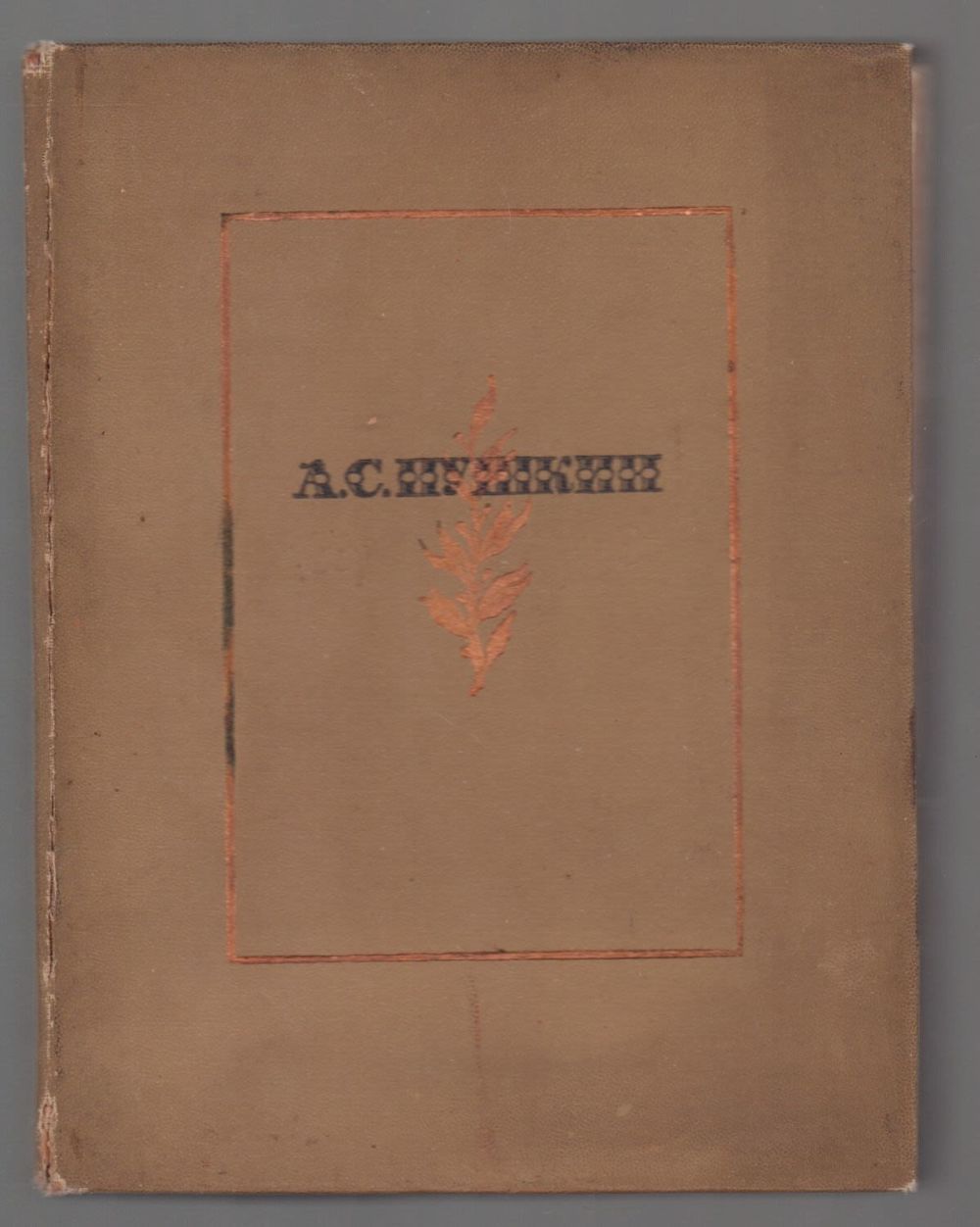
Pushkin, A. S. Mozart and Salieri. Egyptian nights. A miserly knight. A feast during the plague. The Bronze Horseman. The stone guest. [Engravings by A. Kravchenko.] - M. [Goslitizdat. Type Iskra Revolyutsii, 1936. - 29 p., ill.; 47 p., ill.; 39 p., ill.; 23 p., ill.; 38 p., ill.; 62 p., ill. Hardcover books in a publishing calico light-green case with an embossed portrait of Pushkin, reduced format (13.5 x 17.5 cm). The case is slightly soiled and torn without loss; the spine of the book” The Bronze Horseman ” is torn with a slight loss. Anniversary edition for the 100th anniversary of the poet's death. A set of six separate books in a case. Woodcuts by A. Kravchenko. Binding and layout design by Eugene Gogan. [Alexey Kravchenko (1889-1940) Russian artist, master of easel and book graphics, representative of symbolism and Art Nouveau. He studied at the Moscow School of Painting, Sculpture and Architecture (1904-1905, 1907-1910), where his mentors were S. V. Ivanov, K. A. Korovin and V. A. Serov, as well as at the school of S. Holloshi in Munich (1906). At various times, he visited Italy, India, France and the United States. He was a member of the” Association of Wanderers ”(since 1915) and the association” Four Arts ” (since 1925). Initially, he worked in Saratov (1918-1921) as a stage and holiday agitprop artist, then settled in Moscow. He performed mainly as a graphic artist (in the techniques of woodcut and linoleum, etching and drawing). He also willingly turned to tempera and watercolors. He developed the principles of symbolism and art Nouveau in their more traditional, oppositional way to the avant-garde. Lyrical modernism was most organically manifested in the art of the book. These series (illustrations for ”Venediktov” by A.V. Chayanov, 1922; ”The Wooden Queen” by L. M. Leonov, 1923; ”Portrait” by N. V. Gogol, 1928; ”The Lord of Fleas” by E. T. A. Hoffman, 1929; ”The Queen of Spades” by A. S. Pushkin, 1939-1940; etc.) are dominated by the element of irrational, truly ”Hoffmanian” grotesque, dynamically appearing in the game of black-and-white contrasts. ]