Subasta Bidspirit | HERBERT PLOBERGER* (Wels 1902 -
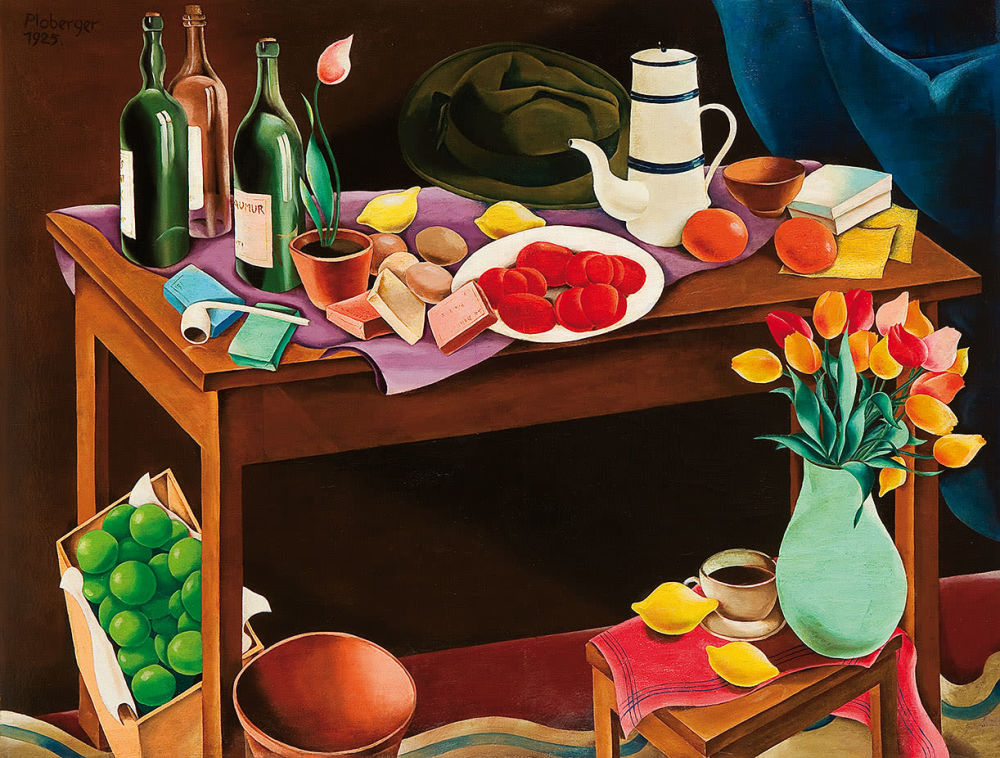
HERBERT PLOBERGER* (Wels 1902 - 1977 Munich) - HERBERT PLOBERGER* (Wels 1902 - 1977 Munich). HERBERT PLOBERGER* (Wels 1902 - 1977 Munich) On the table, under the table oil/canvas, 89 x 116 cm signed Ploberger and dated 1925 exhibited and illustrated in the catalogs of the exhibitions Herbert Ploberger, Life and Work, Lebensspuren Wels and NORDICO Linz 2002, p. 60; in Herbert Ploberger, paintings and graphics, 100th birthday, Landesgalerie Linz 2005, p. 86; in Herbert Ploberger, Im Spannungsfeld zwischen bildender und angewandter Kunst, Landesgalerie Linz 2019, p. 112 depicted in Kunstjahrbuch Linz 1979, p. 52, fig. 4 Provenance: private property Austria, Dorotheum Vienna 2001, Gallery Berinson Berlin, private collection Germany, auction im Kinsky 2009 and 2016, Austrian private collection ESTIMATE € 150.000 - 250.000 Austrian painter and costume and stage designer of the 20th century. Main representative of the New Objectivity. Originally from Wels in Upper Austria, studied at the School of Applied Arts in Vienna under Franz Cizek, Alfred Böhm and Victor Schufinsky. In 1925 for a short time in Paris, from 1927 in Berlin. Worked for the magazines Jugend and Querschnitt and as a stage designer with Ludwig Kainer and Ernst Stern, e.g. in 1930 for the premiere of Weißes Rössl under Max Reinhardt and for Clemens Holzmeister at the Felsenreitschule in Salzburg. In 1945, after Vienna and Linz, works for the Theater in der Josefstadt and the Salzburg Festival, and from 1950 again works for film in Hamburg and Munich. In addition to works for stage and film, mainly oil paintings with self-portraits and still lifes completely committed to the New Objectivity. However, the life's work of this versatile artist encompasses much more than his unique neo-objective paintings. Ploberger was not only a visual artist, but also an applied artist, working as a costume and set designer for theater, film and television in Linz, Vienna, Berlin, Hamburg and Munich. With his Berlin anti-war paintings, he also made weighty artistic contributions to contemporary history. Among his unique still lifes, hcreated between 1925 and 1929 in Paris, Vienna and Berlin, the painting ”On the Table Under the Table” from 1925 presented here is undoubtedly one of the highlights of his painting art. However, the life's work of this versatile artist encompasses much more than his unique neo-objective paintings. Ploberger was not only a visual artist, but also an applied artist, working as a costume and set designer for theater, film and television in Linz, Vienna, Berlin, Hamburg and Munich. With his Berlin anti-war paintings, he also made weighty artistic contributions to contemporary history. Among his unique still lifes, created between 1925 and 1929 in Paris, Vienna and Berlin, the painting ”On the Table Under the Table” from 1925 presented here is undoubtedly one of the highlights of his painting art. At the same time, it also marks a decisive turning point in his education. Ploberger received his artistic training at the School of Applied Arts in Vienna, where he studied from 1920 to 1925 under the professors Adolf Böhm, Franz Cižek, Erich Mallina and Viktor Schufinsky, changing classes several times - from the nude class to the ”class for signs and forms based on the human figure” and finally to the course in ”ornamental form theory”. During this period of study, Ploberger explored the creative possibilities of Constructivism as well as Kinetism. In March 1925, Ploberger then left for Paris, ”where he painted pictures and, in order to finance his life, painted pavilions for the World's Fair of that time” - according to his marginal note in his later written curriculum vitae. At this ”Exposition Internationale des Arts Decorativs et Industriels Modernes, ” students of the Vienna School of Applied Arts from the classes of Franz Cižek, Alfred Böhm, and Erich Mallina showed their work. During his four-month stay in Paris, Ploberger probably also painted this still life, which is the only surviving work from 1925 and is thus considered the earliest painting in his oeuvre. Ingrid Radauer-Helm has therefore also paid special attention to this still life in her monograph published in 2019 on the occasion of the exhibition in the Landesgalerie Linz: ”Gathered on a table are empty bottles, a coffee pot, a potted plant, tomatoes and citrus fruits, eggs, small boxes and packaging, as well as a hat and a pipe. Below, a crate of limes seems to float above the floor. Crowded on a stool are a full coffee cup, two lemons, and a vase full of tulips. Some of the objects, such as the hat, are partially suspended in mid-air. There is no clear perspective in this depiction; the things seem animated, their arrangement relative to one another seeming to give them a life of their own. Several billowing, undulating scarves add to the restless effect. This work has an almost surreal aura and thus contrasts with the later still lifes,